 일본의 화장품시장 분석 및 진출 방안 연구 (영문).docx 일본의 화장품시장 분석 및 진출 방안 연구 (영문).docx |
 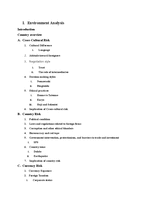 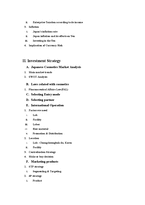  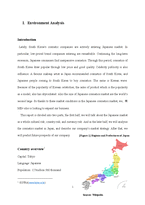 |
목차 I. Environment Analysis Introduction Country overview A. Cross-Cultural Risk 1. Cultural Difference i. Language 2. Attitude toward foreigners 3. Negotiation style i. Trust ii. The role of intermediaries 4. Decision-making styles i. Nemawashi ii. Ringiseido 5. Ethical practices i. Honne vs Tatemae ii. Enryo iii. Haji and Sekentei 6. Implication of Cross-cultural risk B. Country Risk 1. Political condition 2. Laws and regulations related to foreign firms 3. Corruption and other ethical blunders 4. Bureaucracy and red tape 5. Government intervention, protectionism, and barriers to trade and investment i. SPS 6. Country issue i. Dokdo ii. Earthquake 7. Implication of country risk C. Currency Risk 1. Currency Exposure 2. Foreign Taxation i. Corporate status ii. Enterprise Taxation according to its income 3. Inflation i. Japan's inflation rate ii. Japan inflation and its effects on Yen iii. Investing in the Yen 4. Implication of Currency Risk II. Investment Strategy A. Japanese Cosmetics Market Analysis 1. Main market trends 2. SWOT Analysis B. Laws related with cosmetics 1. Pharmaceutical Affairs Law(PAL) C. Selecting Entry mode D. Selecting partner E. International Operation 1. Factors we need i. Lab ii. Facility iii. Labor iv. Raw material v. Promotion & Distribution 2. Location i. Lab Chungcheongbuk-do, Korea ii. Facility 3. Centralization Strategy 4. Make or buy decision F. Marketing products 1. STP strategy i. Segmenting & Targeting 2. 4P strategy i. Product ii. Price iii. Place iv. Promotion v. Branding G. HRM III. Conclusion Reference 본문 I. Environment Analysis Introduction Lately, South Korea s cosmetic companies are actively entering Japanese market. In particular, low-priced brand companies entering are remarkable. Continuing the long-term recession, Japanese consumers find inexpensive cosmetics. Through this period, cosmetics of South Korea draw popular through low price and good quality. Celebrity publicity is also influence. A famous makeup artist in Japan recommended cosmetics of South Korea, and Japanese people coming to South Korea to buy cosmetics. The same is Korean wave. Because of the popularity of Korean celebrities, the sales of product which is the popularity as a model, also has skyrocketed. Also the size of Japanese cosmetics market are the world's second large. So thanks to these market conditions in the Japanese cosmetics market, we, 美ME+ also is looking to expand our business. This report is divided into two parts, the first half; we will talk about the Japanese market as a whole cultural risk, country risk, and currency risk. And in the later half; we will analysis the cosmetics market in Japan, and describe our company's market strategy. After that, we will predict future prospects of our company. 참고문헌 Books 1) Understanding of Japan, Thaehaksa, 2006 2) Chrysanthemum and the sword, Ruth Benedict, 1946 Report 1) UCHI-SOTO (INSIDE-OUTSIDE): LANGUAGE AND CULTURE IN CONTEXT FOR THE JAPANESE AS A FOREIGN LANGUAGE (JFL) LEARNER, Jamie Louise Goekler, 2010 2) Negotiating International Business, Lothar Katz, 2008 3) Decision Making Processes in Japanese Management, Klaus Karki, Sophia University in Tokyo 4) Communicating with Japanese in Business, JETRO, 1999 5) Management Practices in the United States, Japan, and the People s Republic of China, Industrial Management, Heinz Weihrich 6) 2011 Report on Sanitary and phytosanitary Measures, Ambassador Ronald Kirk 7) AMB Country Risk Report, September 28, 2011 8) Capital Markets special report, National Association of Insurance Commissioners, 2011 9) Guidebook for Export to Japan 2011, JETRO 10) Research for global cosmetic market, Foundation of Korea Cosmetic Industry Institute Chungcheongbuk-do;4.9232, Survey of Business Activities, Korean Statistical Information Service, 2009, 2-digit 10) Number of population in Kobe, City of Kobe, 2009 11) Changes in proportion of R&D cost comparing to sales, Korea Cosmetic Association, 1997-2007 12) Cosmetics and Toiletries Market Overview, U.S. Commercial Service Site 1) Kotra (Korea Trade-Investment Promotion Agency)(www.kotra.or.kr) 2) JETRO (http://www.jetro.go.jp/) 3) Background Note: Japan, U.S. Department of State (http://www.state.gov), March 5, 2012 4) 2012 index of economic freedom (http://www.heritage.org/index/country/japan) 5) Korea Japan Cooperation Foundation (www.kjc.or.kr) 6) Australian Trade Commission (http://www.austrade.gov.au/) 7) Yano Economic Research Institute (http://www.yanoresearch.com/) 8) 2011 - 2012 Tax Rate Guide and Tax Help Website, 2012 (http://www.taxrates.cc/html/japan-tax-rates.html) 9) Chungbuk Techno Park Bio Center, (http://www.cbtp.or.kr/bio/index.php) 10) Invest KOBE (http://www.city.kobe.lg.jp/business/attract/invest-kobe/e/project/iryo/index.html) News 1) ABC news, March 13, 2011 (http://abcnews.go.com/International/japanese-bureaucracy-delays-foreign-search-rescue-teams/story?id=13126904#.T9F6UFIldQs) 2) The Territorial Dispute Over Dokdo Final, Korea Town News, 17 Aug 2008 (www.kncolorado.com) 3) "How Does Employee Motivation Impact Organizational Performance", Shemiah Williams, 20 April 2011 4) BUREAUCRACY IN JAPAN: HISTORY, DAILY LIFE, POWERFUL MINISTRIES, AMAKUDARI AND REFORMS, Facts and details, (http://factsanddetails.com/japan.php?itemid=800&catid=22&subcatid=146) 5) The Issue of Takeshima, Ministry of Foreign Affairs of Japan (www.mofa.go.jp) 6) Information about Investment in Kobe, Jetro, (https://www.jetro.go.jp/en/invest/region/icinfo/kobe-city/) 키워드 진출, 화장품시장, 분석, 연구, 일본 |
2017년 6월 15일 목요일
일본의 화장품시장 분석 및 진출 방안 연구 (영문)
일본의 화장품시장 분석 및 진출 방안 연구 (영문)

피드 구독하기:
댓글 (Atom)
댓글 없음:
댓글 쓰기