 한국, 중국, 일본의 식품 소비 비교(영문).hwp 한국, 중국, 일본의 식품 소비 비교(영문).hwp |
 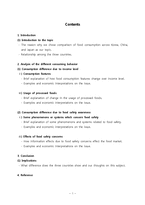 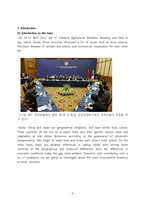   |
목차 1. Introduction (1) Introduction to the topic - The reason why we chose comparison of food consumption across Korea, China, and Japan as our topic. - Relationship among the three countries. 2. Analysis of the different consuming behavior (1) Consumption difference due to income level ⅰ) Consumption features - Brief explanation of how food consumption features change over income level. - Examples and economic interpretations on the issue. ⅱ) Usage of processed foods - Brief explanation of change in the usage of processed foods. - Examples and economic interpretations on the issue. (2) Consumption difference due to food safety awareness ⅰ) Some phenomenons or systems which concern food safety - Brief explanation of some phenomenons and systems related to food safety. - Examples and economic interpretations on the issue. ⅱ) Effects of food safety concerns - How information effects due to food safety concerns effect the food market. - Examples and economic interpretations on the issue. 3. Conclusion (1) Implications - What difference does the three countries show and our thoughts on this subject. 4. Reference 본문 1. Introduction (1) Introduction to the topic On 14-15 April 2012, the 1st Trilateral Agricultural Ministers' Meeting was hold in Jeju Island, Korea. Three countries discussed a lot of issues such as food security, infectious diseases of animals and plants, and economical cooperation for each other etc. <15일 제주 롯데호텔에서 열린 제1차 한 중 일 농업장관회의에서 관계자들이 토론을 하고 있다.> Korea, China, and Japan are geographical neighbors, and have similar food culture. Three countries all eat rice as a staple food, and then garnish various meat and vegetables as side dishes. Moreover, according to the appearance of convenient transportation, they begin to trade food and share each other's food culture. On the other hand, there are detailed differences in eating habits exist among three countries as the geographical and resources differences. Also, the differences of economic conditions make the gap more evident. Therefore, with considering such a lot of conditions, we are going to investigate about the food consumption tendency of three countries. 참고문헌 * Graphs extracted from professor Ahn s ppt lecture. * www.bok.or.kr * www.kostat.go.kr * 일본 후생노동청, 2008, 「국민건강 영양조사보고」 * 중국 국가기록원, 2008, 「2007中國城市生活與價 年鑒」 * 「한중일 청소년의 식품소비 비교분석」, 이계임 저 * aT Focus 2012년 3월호 (발행처: 한국농수산식품유통공사) * Lu Xiaojing , 2011. The Cause and Effect Analysis of the Melamine Incident in China. Asian Journal of Agricultural Research, 5: 176-185. * USDA Foreign Agricultural Service Office of Global Analysis, 2010. Dairy: World Markets and Trade. * M. Woolsey, J.p. Zhang, S.Zhang , 2010. Dairy and Products Annual 2010 * Hongjun Zhu, How milk standards triggered uproar in China , 中外 . 31 August 2012 * Martin J. Frid, Food Safety in Japan: One Year After the Nuclear Disaster, The Asia-Pacific Journal, Vol 10, Issue 12, No 1, March 19, 2012. * FoxNews.com, Japan s Nuclear Disaster Raises Concerns About Contamination of the Global Food Chain , 21 March 2011 * Understanding and Needs of Consumers, Producers Regarding Traceability of Agri-products-이철희, 이영주, 심근섭(2005) * Comparative Study for the Development of Korean Food Safety Management-유현정, 송유진(2010) * A Comparison of Korean and Japanese Consumers` Willingness to Pay for Food-Safety-김인섭(2007) 키워드 소비, 비교, 영문, 일본, 중국, 한국 |
2017년 1월 12일 목요일
한국, 중국, 일본의 식품 소비 비교(영문)
한국, 중국, 일본의 식품 소비 비교(영문)

피드 구독하기:
댓글 (Atom)
댓글 없음:
댓글 쓰기